
Moving to a new country is an adventure that requires careful planning, research, and a proactive approach. Whether you are relocating to the modern style of Riyadh or the coastal landscape of Jeddah, the first week is often a whirlwind of administrative tasks and cultural adjustments. While your professional relocation partner, KIM International Movers, handles the heavy lifting of your household goods, your focus will shift toward establishing your new life in the Kingdom. Understanding what to do in the first 7 days after arriving in Saudi Arabia is essential to ensure a smooth transition and avoid the “nightmare” of logistical delays.
Table of Contents
- What To Do In The First 7 Days After Arriving In Saudi Arabia
- Day 1: Establishing Connectivity and Document Safety
- Day 2: Beginning the Iqama (Residence Permit) Process
- Day 3: Orientation and Home Search
- Day 4: Opening a Bank Account
- Day 5: Finalizing the Tenancy Agreement and Utilities
- Day 6: Mobility and Vehicle Arrangements
- Day 7: Receiving Your Shipment and Final Settlement
What To Do In The First 7 Days After Arriving In Saudi Arabia
Successfully settling into the Kingdom involves a series of interconnected steps, ranging from securing communication to finalizing legal residency. By following a methodical 7-day plan, you can navigate these challenges with the same “Keen, Insightful, and Mindful” precision that KIM International Movers applies to your relocation.
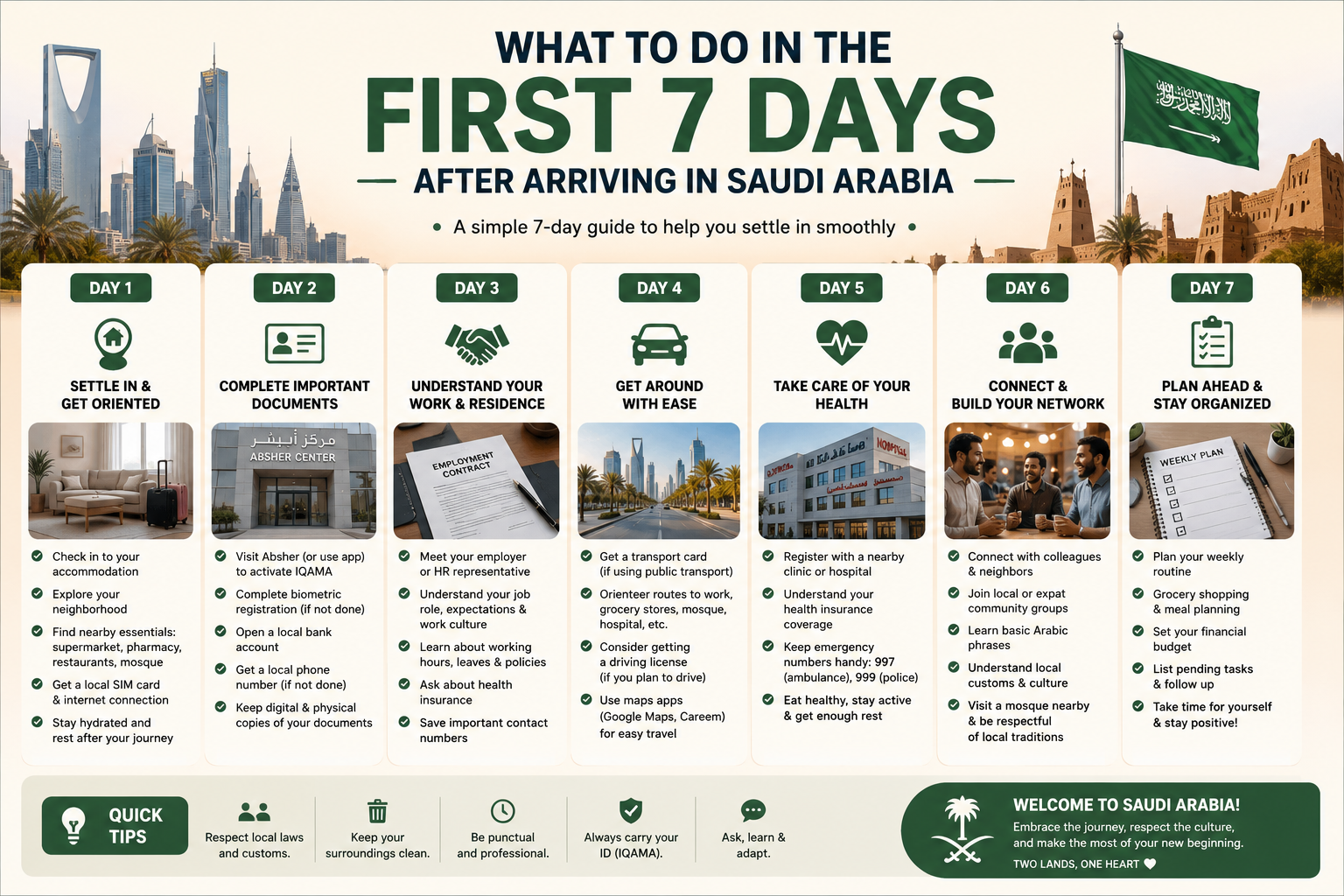
Day 1: Establishing Connectivity and Document Safety
The moment you arrive, communication is your most valuable tool. Your first task is to secure a local SIM card. While major airports have kiosks for local telecom providers, you will need your passport and your “Border Number” (written in your passport by immigration) to register. This number acts as your temporary identification until your Iqama is processed.
This is also the time to secure your most vital items. You are entirely responsible for the transit of money, jewelry, and important documents. You should have already set aside a “DO NOT REMOVE” carton containing your passports, birth certificates, and marriage licenses. Keep this box with you personally at your temporary accommodation rather than in the general shipping container.
Day 2: Beginning the Iqama (Residence Permit) Process
The Iqama is the most critical document for any expat in Saudi Arabia. It is required for everything from opening a bank account to clearing customs for your household goods. Your employer or sponsor will usually initiate this process immediately upon your arrival.
On your second day, you will likely be scheduled for a medical examination. This is a mandatory step for the residency permit and involves blood tests and health screenings at an approved clinic. You may also need to visit a government office to provide biometrics (fingerprints and photos). Because professional movers like KIM International Movers handle the “hassle-free” transport of your belongings, you can dedicate this day fully to these essential legal appointments.
Day 3: Orientation and Home Search
Once the initial paperwork is in motion, you should begin exploring your housing options. Many expats choose to live in compounds or standard apartments, depending on their budget and lifestyle. Professional relocation managers can provide “home search” and “orientation trips” to help you understand different neighborhoods.
During these visits, consider the commute to your workplace and the proximity to international schools if you are moving with children. This is also an excellent time to look into “intercultural training” to help you and your family embrace the local diversity and cultural differences you will encounter.
Day 4: Opening a Bank Account
Once you have your Iqama (or in some cases, your passport and a letter of introduction from your employer), you can visit a local bank. A Saudi bank account is necessary for receiving your salary, paying rent, and setting up utilities.
When you open your account, ensure your name matches the spelling on your passport and Iqama exactly to avoid future delays. Most banks will provide you with a debit card immediately, which you can then link to digital payment apps. This financial foundation is a key part of the “end-to-end solution” for settling in.
Day 5: Finalizing the Tenancy Agreement and Utilities
With a bank account and a chosen home, the next step is signing the rental contract. In Saudi Arabia, most residential leases are registered through a unified electronic system (Ejar) to protect the rights of both parties.
Once the contract is signed, you must register for your own utility accounts. This includes electricity and water services. In many modern buildings, your relocation manager or “settling-in” service can assist with these applications. Having your utilities active is vital before your furniture arrives so that KIM International Movers can efficiently deliver and reassemble your items in a comfortable, air-conditioned environment.
Day 6: Mobility and Vehicle Arrangements
Public transport is developing rapidly in major cities like Riyadh, but many expats still find that a personal vehicle is necessary for daily life. On Day 6, you should look into your mobility options. You may decide to purchase a vehicle locally or use a “car carrier service” to ship your own car or motorcycle from abroad.
If you are shipping a vehicle, professional movers will carry out a detailed inspection with you present to note any pre-existing damage. They also provide “360-degree protection” to ensure your car arrives safely. If you are buying locally, this day is spent visiting showrooms or exploring long-term rental options.
Day 7: Receiving Your Shipment and Final Settlement
By the end of your first week, your legal status should be progressing, and your new home should be ready. This is typically when your international shipment is cleared through customs and delivered.
KIM International Movers will provide a comprehensive delivery service that includes:
- Expert handling: Unloading and placing boxes in their designated rooms.
- Furniture reassembly: Skilled teams dismantle and then reassemble your beds, cupboards, and tables.
- Unpacking: Removing your items from their export-grade materials.
- Rubbish removal: Taking away the packing materials so you can enjoy your new space immediately.
Surviving the first week in a new country requires a balance of administrative diligence and cultural patience. From the initial medical exams for your Iqama to the final unpacking of your family heirlooms, every task brings you closer to a successful relocation. By understanding what to do in the first 7 days after arriving in Saudi Arabia, you can transform a complex transition into a well-managed and rewarding experience.
Relying on the “Keen, Insightful, and Mindful” expertise of KIM International Movers allows you to focus on these critical settling-in tasks while they ensure your belongings are handled with precision and care. Whether you are starting a new career or a fresh chapter for your family, the right preparation during your first week ensures that your journey in the Kingdom begins with confidence and peace of mind.